



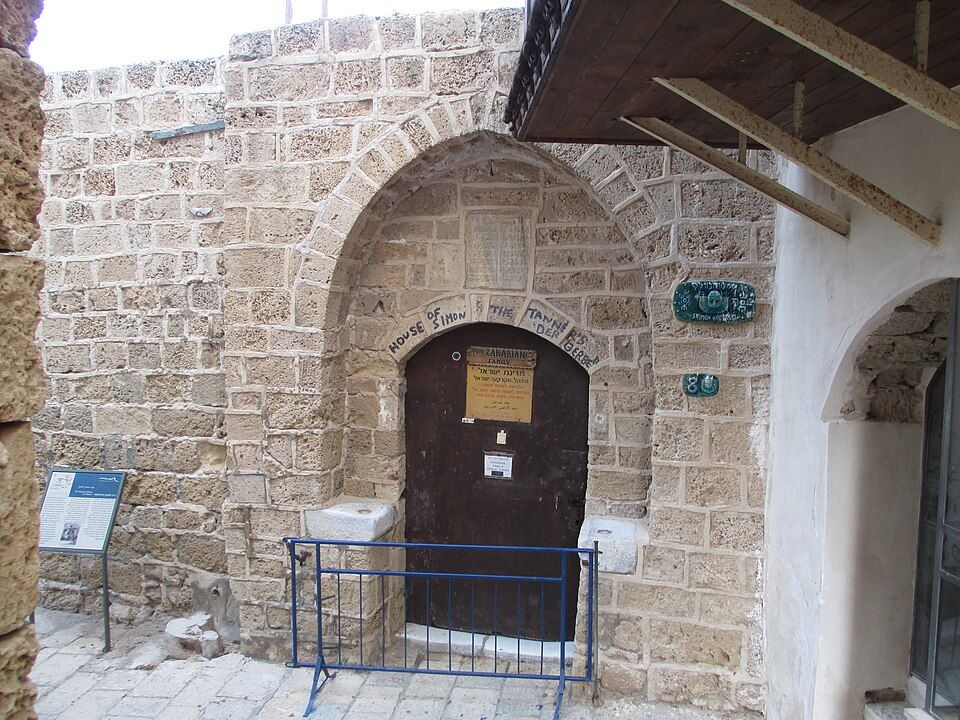
In the narrow alleyways of old Jaffa, near the ancient port, stands a small stone house that tradition identifies as the home of Simon the Tanner. According to the Book of Acts, it was on this rooftop, overlooking the Mediterranean Sea, that the Apostle Peter received a vision that would fundamentally change the course of Christianity, opening the faith to non-Jews and transforming it from a Jewish sect into a universal religion. For Christian pilgrims visiting the Holy Land, this modest house carries a weight of meaning far beyond its humble appearance. Standing here, at the edge of the sea, visitors find themselves at the geographic origin point of a theological revolution that shaped the history of the world.
Peter in Jaffa: A Tanner, a Saint, and a Turning Point
The story of Peter in Jaffa begins not with the famous vision but with a miracle. According to Acts 9:36–43, a beloved disciple named Tabitha, called Dorcas in Greek, had died in Jaffa. She was known throughout the community for her acts of charity, and her fellow believers sent for Peter, who was then in the nearby town of Lydda. Peter came, knelt beside her body, and prayed. He said simply, “Tabitha, arise.” She opened her eyes, and Peter presented her alive to the community. The miracle spread throughout Jaffa, and many believed. It was in the wake of this event that Peter chose to remain in the city, staying “many days in Jaffa with a certain Simon, a tanner” (Acts 9:43).
The detail about Simon’s profession is not incidental. A tanner worked with animal hides, a trade that involved the handling of dead animals and was considered ritually impure under Jewish law. As a result, tanners traditionally lived on the outskirts of towns, often near the sea, where the smell of their work would be carried away by the wind. That Peter, a devout Jew who had followed strict purity laws his entire life, chose to lodge in a tanner’s house was already a sign of spiritual movement, a loosening of the boundaries between clean and unclean, sacred and profane. Many scholars who study this passage note that Peter’s choice of host was itself a prelude to the vision that would follow.
The Vision on the Rooftop: A Sheet from Heaven
The vision that tradition holds Peter received at Simon’s house is recorded in Acts 10:9–16, and it is one of the most theologically consequential passages in the New Testament. At noon, Peter went up to the rooftop of the house to pray. He was hungry and waiting for a meal to be prepared when he fell into a trance. What he saw was a great sheet, held at its four corners, descending from heaven. In the sheet were all kinds of animals, four-footed creatures, reptiles, and birds, both those considered clean and those considered unclean under Jewish dietary law. A voice commanded him: “Rise, Peter; kill and eat.”
Peter’s response was immediate and deeply rooted in his upbringing: “By no means, Lord; for I have never eaten anything impure or unclean.” The voice answered: “What God has made clean, do not call impure.” This exchange happened three times, a pattern echoing Peter’s three denials of Jesus and his three-fold restoration, before the sheet was taken back up to heaven. The vision left Peter perplexed, wondering what it could mean. He did not have to wonder long. At that very moment, messengers sent by the Roman centurion Cornelius arrived at the gate below, asking for Peter by name. The two events, the vision and the summons, were inseparable by design.
Peter and Cornelius: The Door Opens to the Gentiles
Cornelius was a Roman centurion stationed in Caesarea Maritima, roughly 50 kilometers north of Jaffa along the Mediterranean coast. He is described in Acts 10 as a devout man who feared God, gave generously to the poor, and prayed regularly, yet he was not Jewish, and by the social and religious norms of the time, a Jewish teacher had no business entering his home. Nevertheless, guided by his own vision from an angel, Cornelius had sent messengers to find Peter. And Peter, having received the vision on the rooftop, went with them. When he arrived at Cornelius’s house and found a large gathering assembled, he said words that would echo across centuries of Christian history: “God has shown me that I should not call anyone impure or unclean.”
What followed is believed to be the first recorded instance of a Gentile household receiving the Holy Spirit. As Peter preached, the Spirit fell upon all who were listening. The Jewish believers who had accompanied Peter were astonished that the gift of the Holy Spirit had been poured out even on Gentiles. Peter responded by ordering that Cornelius and his household be baptized in the name of Jesus Christ. The event was so significant that Peter was later called to Jerusalem to explain himself, and his account of the vision from Jaffa silenced all objections. Tradition holds that this moment marked the formal opening of the early Church to non-Jewish believers, and it is from this rooftop in Jaffa that the chain of events began.
The House Today: A Modest Site with an Enormous Legacy
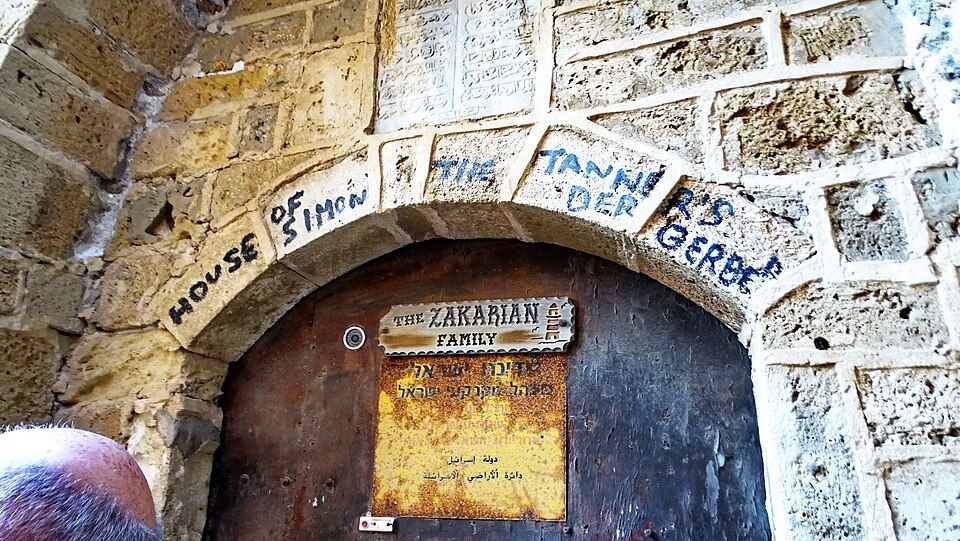
The traditional site believed to be Simon the Tanner’s house is a small Ottoman-era stone structure located near the Jaffa lighthouse, close to the southern edge of old Jaffa. A modest sign marks the location, identifying it as the traditional site associated with the Acts narrative. The rooftop, or what remains accessible of it, still offers views over the Mediterranean Sea, the same horizon Peter would have looked toward on that noon when tradition holds the vision descended from heaven. The setting has a quiet, unassuming quality that many pilgrims find more moving than a grand basilica: there is no altar, no incense, no choir, only stone and sea and sky.
The house is privately owned, and access to the interior can be limited or subject to change. The courtyard area is generally accessible, and visitors often pause here for prayer or quiet reflection. Unlike many holy sites in the Holy Land, surrounded by churches, monasteries, and the full apparatus of religious tourism, Simon the Tanner’s house remains simply a house, with a tradition attached. That modesty is part of its power. It asks visitors to exercise the same imaginative faith that the Acts narrative itself requires: to see in an ordinary place the location of an extraordinary encounter between the human and the divine.
Visit with Hoshen Tours
A visit to Simon the Tanner pairs beautifully with nearby destinations along your route. Consider combining it with a stop at Jaffa or Jaffa Flea Market, both just a short drive away. Many travelers also enjoy exploring American Colony in Jaffa and Tel Aviv on the same day, while HaTachana offers another worthwhile addition to your itinerary. Your Hoshen Tours guide will craft a seamless route that brings each destination to life with expert commentary and insider knowledge.
Explore Our Tour Collection
Ready to experience Israel in true colors?
Plan Your TourPrivate tours designed around your interests, schedule, and pace.