



The Mahmoudiya Mosque is the largest mosque in Jaffa, originally built around 1730 and largely rebuilt in 1812 by Muhammad Abu Nabbut, the Ottoman governor of the city. It stands on Yefet Street near the Clock Tower and the entrance to Old Jaffa, its minaret a landmark of the Jaffa skyline.
Napoleon and Jaffa
To understand why the mosque was built, it helps to know what happened to Jaffa just thirteen years earlier. In 1799, Napoleon Bonaparte besieged and captured the city during his Egyptian campaign. The French forces killed thousands of its inhabitants and left Jaffa severely damaged. The city that Abu Nabbut inherited when he became governor in 1807 was still scarred by that violence. His ambitious construction program, of which the mosque was the centerpiece, was part of a deliberate effort to rebuild and reassert Ottoman authority over a city that had been traumatized. The mosque was not just a place of worship. It was a statement.
Abu Nabbut
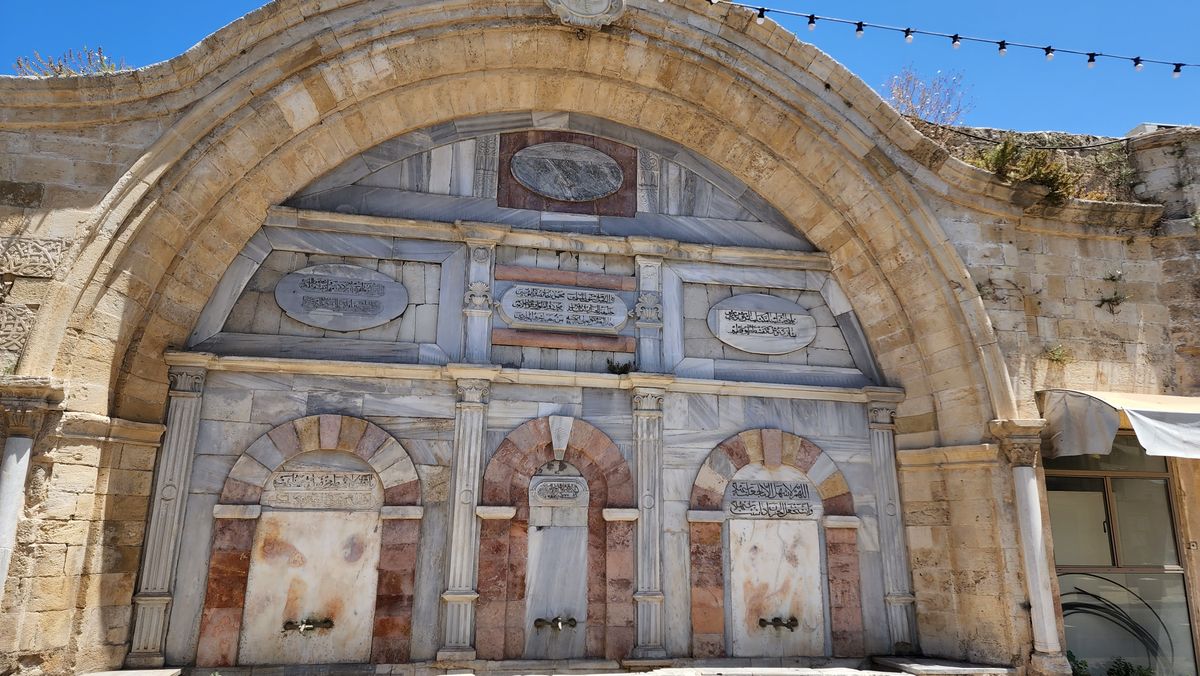
Muhammad Abu Nabbut (“Father of the Mace,” named for the club he reportedly always carried) served as the Ottoman governor of Jaffa from approximately 1807 to 1818. He was a forceful ruler who undertook major construction projects in the city, and the mosque is his most enduring legacy. He also built two ornate sabils (public drinking fountains) nearby, decorated with calligraphic inscriptions, as charitable works providing free water to passersby and travelers. The sabils, dating to 1815 to 1816, are among the finest examples of Ottoman public architecture in Jaffa.
Ottoman Architecture and the Courtyard
The mosque features a central courtyard, arched colonnades, and a prominent minaret built in late Ottoman style with local stone. The interior includes columns, some of them spolia, ancient columns reused from earlier structures, a common practice across the region’s history. The prayer hall has vaulted ceiling sections and the courtyard provides a quiet retreat from the bustle of Yefet Street outside. Non-Muslims are generally not permitted to enter the prayer hall itself, but the courtyard and the exterior architecture can be observed from outside, and the minaret is visible from much of the surrounding neighborhood.
Jaffa’s Ottoman Heritage
The Mahmoudiya Mosque belongs to a broader Ottoman architectural heritage that shaped Jaffa during the 18th and 19th centuries. After Napoleon’s destructive campaign, Ottoman governors like Abu Nabbut invested in public infrastructure to restore the city’s commercial and religious life. The mosque’s construction drew on local limestone and incorporated building traditions from across the Ottoman Empire, including the reuse of ancient columns from earlier Roman and Byzantine structures found in the area. The sabil fountains that Abu Nabbut erected nearby, with their ornate Arabic calligraphy and floral relief carvings, remain among the best-preserved examples of Ottoman civic architecture along Israel’s coast. Together with the nearby Clock Tower (built in 1903 to mark Sultan Abdul Hamid II’s jubilee), these structures form a coherent Ottoman architectural ensemble that gives Jaffa much of its distinctive character.
Visit with Hoshen Tours
The Mahmoudiya Mosque is part of the Ottoman layer of Jaffa’s history. Hoshen Tours passes the mosque, the sabils, and the Clock Tower on the walk into Old Jaffa, telling the story of the Ottoman centuries that shaped the city between the Crusades and the modern era. Hoshen Tours often combines this site with Migdal Tzedek, Simon the Tanner, and Eretz Israel Museum for a memorable day exploring the region.
Explore Our Tour Collection
Ready to experience Israel in true colors?
Plan Your TourPrivate tours designed around your interests, schedule, and pace.