



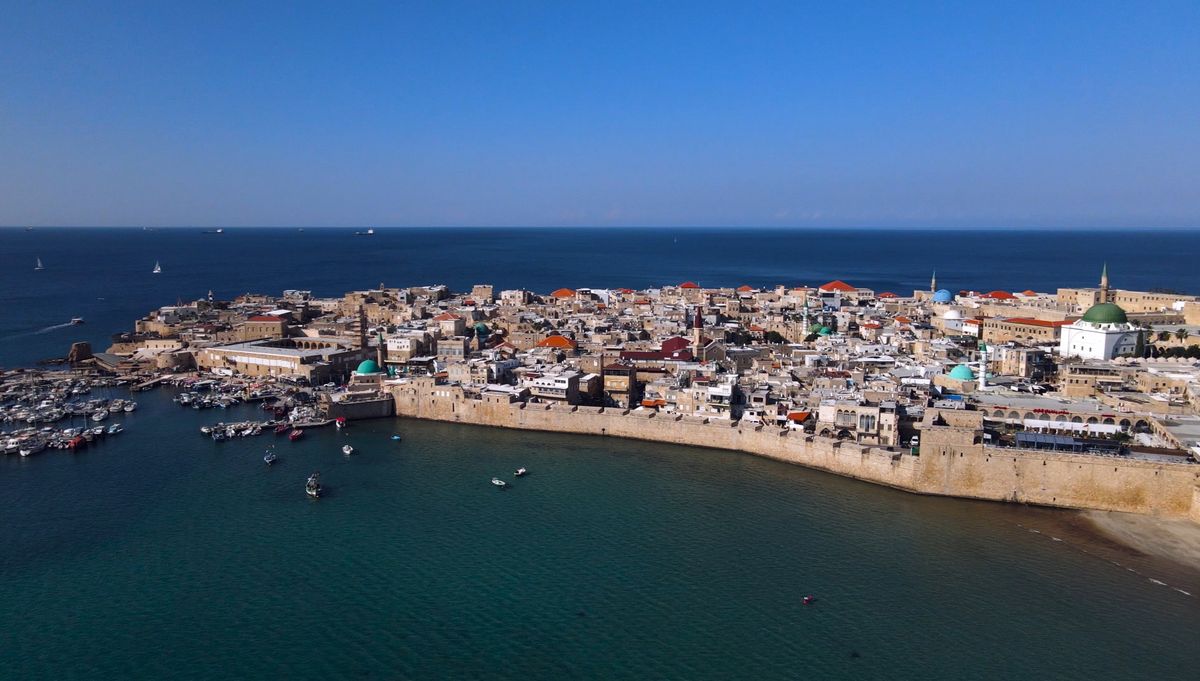
 Akko (Acre, Acco) is one of the oldest continuously inhabited cities on earth, a port on the northern curve of Haifa Bay where human settlement stretches back more than four thousand years. Virtually every empire that has ever dominated the eastern Mediterranean has planted its flag here: Egyptians, Canaanites, Phoenicians, Assyrians, Persians, Greeks, Romans, Arabs, Crusaders, Mamluks, Ottomans, Napoleon (briefly and unsuccessfully), the British, and the modern State of Israel. UNESCO recognized the Old City as a World Heritage Site in 2001, describing it as an exceptional Ottoman walled town built on top of a Crusader city, itself built on top of everything before. Walking through Akko is a compressed journey through the entire history of the Levant, layer by layer, all within the same few square kilometers of windswept coastline. Each left something behind in the stone, and in Akko you can read it all.
Ancient Akko Israel: Bronze Age to the Iron Age
Akko is among the oldest cities on earth with a documented paper trail. Egyptian records from the 19th century BCE already name it as a Canaanite settlement, and Thutmose III catalogued it among his conquests in the 15th century BCE. The Book of Judges records simply: “Asher did not drive out those living in Akko or Sidon” (Judges 1:31), acknowledging the city remained Canaanite and Phoenician territory even as Israelite tribes settled the surrounding highlands. Its natural harbor made it too valuable to displace. Akko flourished as a Phoenician trading port through the Iron Age, connected by sea to Cyprus, Greece, and Egypt, and passed through Assyrian and Persian control without ceasing to function as a working port.
Ptolemais: The Greek and Roman City
Alexander the Great arrived at Akko in 332 BCE. Under the Ptolemies of Egypt, the city was renamed Ptolemais and laid out on the Greek grid plan. When Rome absorbed the region, it became an important military base and commercial node. The Apostle Paul stopped here on his final journey to Jerusalem: “We continued our voyage from Tyre and landed at Ptolemais, where we greeted the brothers and sisters and stayed with them for a day” (Acts 21:7), placing an early Christian community in the city by the mid-first century CE. After Rome came Byzantium, and then, in 636 CE, the Arab armies advancing northward along the coast.
Crusader Capital: The Most Cosmopolitan City in the Medieval World
 Crusader forces took Akko in 1104 and recognized its strategic value immediately. After Saladin’s victory at Hattin in 1187 and the fall of Jerusalem, Richard the Lionheart recaptured Akko on July 12, 1191, after a two-year siege. Jerusalem was never recovered, and Akko became the capital of what remained of the Crusader Kingdom for the next hundred years.
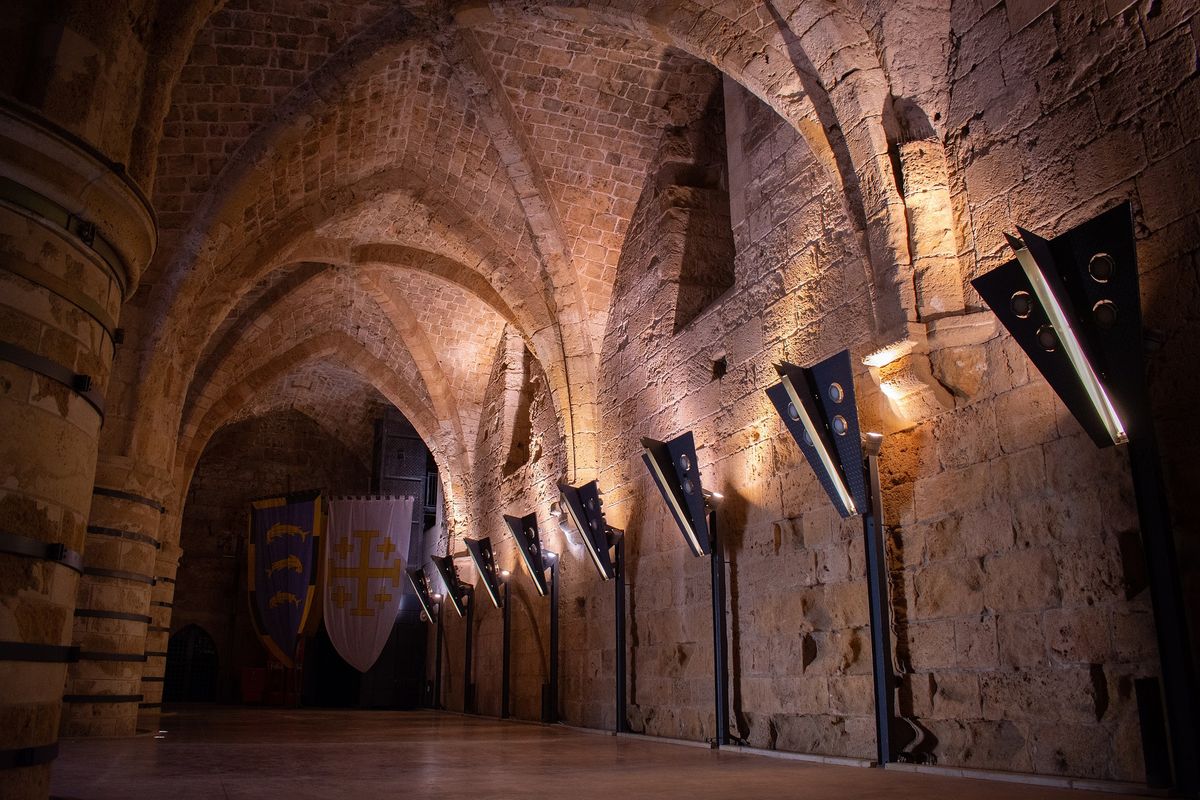
Three great military-religious orders headquartered here: the Knights Hospitaller, whose underground halls, the Knights’ Halls, survive as one of the finest examples of Crusader architecture anywhere; the Knights Templar, who built their fortress in the southwestern corner and dug a secret tunnel to the port, rediscovered in 1994; and the Teutonic Knights. The rabbi and scholar Nahmanides (Ramban) arrived in Akko in 1267 after his exile from Spain and made it his base for the rest of his life. The Italian merchant republics, Venice, Genoa, and Pisa, each maintained their own quarter, warehouses, courts, and militia, and fought one another over trading rights. Marco Polo departed for the East from Akko in 1271. By every measure, Crusader Akko was the beating heart of the medieval Levant.
The Fall of Akko, 1291: The End of the Crusades
The end came on May 18, 1291. Mamluk Sultan al-Ashraf Khalil assembled an enormous army and pressed the siege with relentless force. Inside the city, the Hospitallers and Templars fought side by side in the final defense. The civilian population attempted to flee by sea. On May 18 the outer walls were breached and the city fell in a day of terrible fighting.
The last resistance came from a Templar tower near the harbor. They held out ten days after the city fell, then undermined the foundations, the tower collapsed on defenders and attackers together. The fall of Akko in 1291 ended 187 years of Crusader presence in the Holy Land. The Mamluks systematically demolished the city and its harbor, and Akko lay largely in ruins for the next four centuries.
Daher al-Omar: The Man Who Revived Akko
Born around 1690 into a local Arab family in the Galilee, Daher al-Omar al-Zaydani rose from tax collector to autonomous ruler of much of northern Palestine, with Tiberias as his early base. In 1744 he took Akko, then a decaying village with a silted port, made it his capital, and set about transforming it. He rebuilt the walls using stone salvaged from Crusader ruins, constructed khans for merchants, restored the port, and established Akko as the commercial hub of the coast. His main export was cotton, in high demand in Europe, and he built close relationships with French merchants. In Tiberias he invited Rabbi Haim Abulafia from Izmir to resettle the Jewish community, providing houses and a synagogue. On August 21, 1775, Daher al-Omar was killed while attempting to flee Akko, approximately 85 years old. The city passed to his executioner’s ally: Ahmad Pasha al-Jazzar.
Al-Jazzar: The Butcher Who Fortified the City
Ahmad Pasha al-Jazzar arrived in Akko as a military commander in the campaign that killed Daher al-Omar. Born in Bosnia around 1720, he rose through the Ottoman military to the governorship of the Sidon province in 1776 and made Akko his capital. The Al-Jazzar Mosque (1781), built in Ottoman imperial style with columns salvaged from Roman and Crusader ruins, remains the dominant landmark of the Old City. Most critically, al-Jazzar dramatically strengthened the city’s walls with new fortifications, towers, and artillery platforms, the same defenses that would repel Napoleon twenty years later.
Napoleon’s Defeat: The Campaign That Changed History
In the spring of 1799, Napoleon Bonaparte was at the height of his Egyptian campaign. He had taken Egypt, Gaza, and Jaffa, and his plan was to march north to Akko, take the fortress city, push into Syria and beyond, and reshape the Middle East into a French sphere of influence.
The siege began in March 1799, and Napoleon expected it to be brief. Al-Jazzar organized a fierce defense, and British Commodore Sir Sidney Smith made the crucial difference: his Royal Navy ships intercepted a French convoy carrying Napoleon’s heavy siege artillery, then turned those guns over to the defenders. Smith also supplied intelligence, reinforcements, and naval gunfire that made every assault more costly than the last. For two months Napoleon threw assault after assault at the walls, losing more than 2,000 men, many to plague. On May 20 he gave the order to retreat. Napoleon reportedly said: “If I had taken Acre, I would have changed the destiny of the world.” The walls visitors walk past today are the walls that stopped him.
The Old City Today: Ottoman Streets Above Crusader Vaults
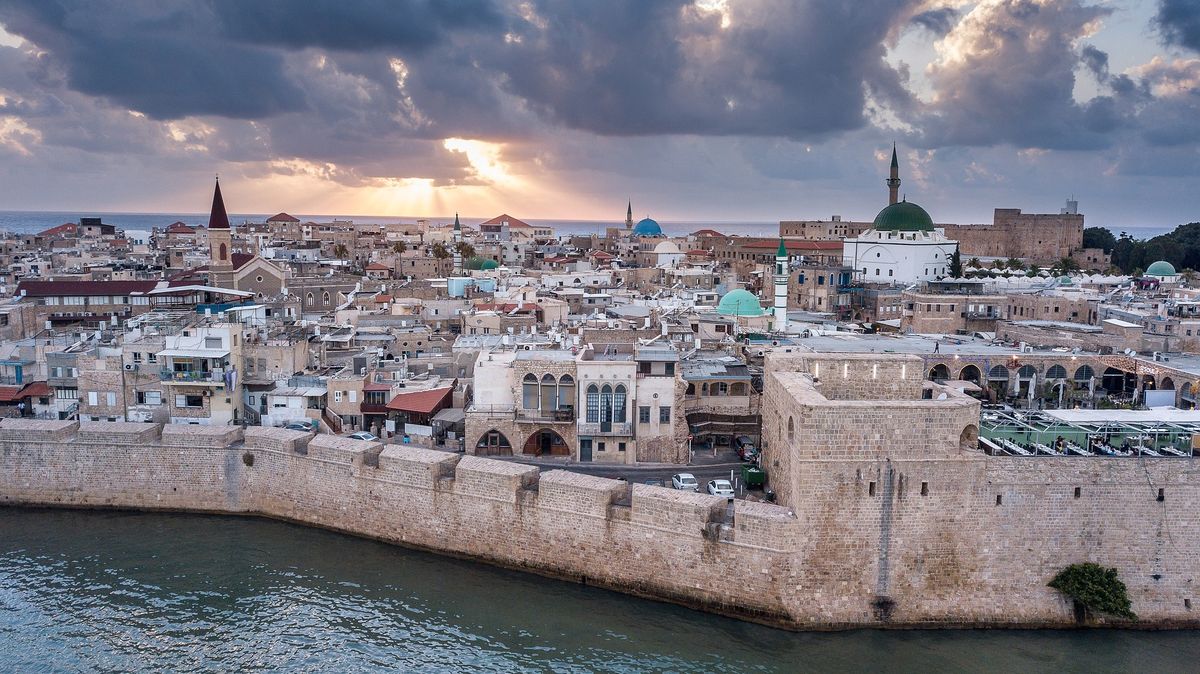 The physical relationship between Akko’s layers is literal: Ottoman streets sit on top of the medieval Crusader city, whose vaulted ceilings support the floors above. The Al-Jazzar Mosque sits above a Crusader cistern. The Templar Tunnel runs beneath houses built, occupied, and forgotten for seven centuries before its rediscovery in 1994.
The Old City is a living neighborhood, not a museum. Some 15,000 people, predominantly Arab, both Muslim and Christian, live and work in the same streets where Crusader knights once walked. The souk is a proper working market: spices measured from open sacks, fresh vegetables, hardware shops, and bakeries alongside stalls selling knafeh and freshly squeezed pomegranate juice. Children play in alleys where Venetian merchants once kept their counting houses. Khan al-Umdan, al-Jazzar’s great caravanserai, still stands in the port area with its Ottoman clock tower added in 1906. The fishing port is an active working harbor where small boats go out each morning. The sea walls, built and rebuilt across four centuries, extend into the Mediterranean and offer one of the finest sunset walks on the coast.
The Ottoman citadel, built by al-Jazzar and later repurposed as the most notorious British prison in Mandate Palestine, held Jewish underground fighters tried and executed within its walls. In May 1947, Irgun fighters blew through the prison wall and freed over 200 prisoners in a daring escape that shook the British administration. (Read more about the Akko Citadel and prison.)
Culinary Akko: A City Worth Eating Through
Akko has a culinary reputation that extends well beyond its archaeological significance. The Old City’s Arab market produces some of the finest hummus in Israel, made fresh each morning, served warm with olive oil and whole chickpeas, sold out by early afternoon. The knafeh, the sweet cheese pastry soaked in sugar syrup, is made here in the Nablus tradition and holds its own against anywhere in the region. The fishing port means fish caught that morning arrives in the restaurants by noon.
Uri Buri, a legendary fish restaurant on the sea wall, has been called one of the best restaurants in Israel consistently and without serious contradiction. Reservations are advisable. Hummus Said, in the market, opens in the morning and closes when the hummus runs out, which happens well before lunch. Eating in Akko is an essential part of what the city is, and the setting, the Ottoman market, the fishing port, the sea air, makes it better. In the heart of the Old City, the Or Torah Synagogue, built by Tunisian Jewish immigrants in the 1950s, is covered floor to ceiling in colorful mosaic tiles (read more).
The Baha’i Connection: A Holy City for the World’s Newest Major Religion
Akko holds a significance in the Baha’i faith that is not widely known but is, within that tradition, of the highest possible order. In 1868, Baha’u’llah, the prophet-founder of the Baha’i religion, who had already been exiled from Persia to Baghdad, then to Istanbul, then to Edirne, was exiled once more to Akko, which the Ottoman authorities chose because it was a fortified prison city. Baha’u’llah arrived under arrest, confined first in the citadel and then in a house within the walls, and tradition holds he spent nearly twenty-four years a prisoner in or near Akko.
In the final years of his life, Baha’u’llah was permitted to move to the Mansion of Bahji, a few kilometers north of Akko, where he died in 1892 and where he is buried. The Shrine of Baha’u’llah at Bahji is the holiest site in the Baha’i world, the direction toward which Baha’is around the globe turn in prayer. Together with the Shrine of the Bab and the Baha’i World Centre in Haifa, Bahji forms the Baha’i World Heritage inscribed by UNESCO in 2008. Many Baha’i pilgrims who visit Haifa extend their journey to Akko and Bahji, completing the circuit of the two cities that constitute the spiritual center of their faith.
Visit with Hoshen Tours
A visit to Akko pairs beautifully with nearby destinations along your route. Consider combining it with a stop at Knights Halls in Akko or Tunisian Synagogue in Akko, both just a short drive away. Many travelers also enjoy exploring Akko Prison and Templar Tunnel in Akko on the same day, while Rosh HaNikra offers another worthwhile addition to your itinerary. Your Hoshen Tours guide will craft a seamless route that brings each destination to life with expert commentary and insider knowledge.
Ready to experience Israel in true colors?
Plan Your TourPrivate tours designed around your interests, schedule, and pace.