



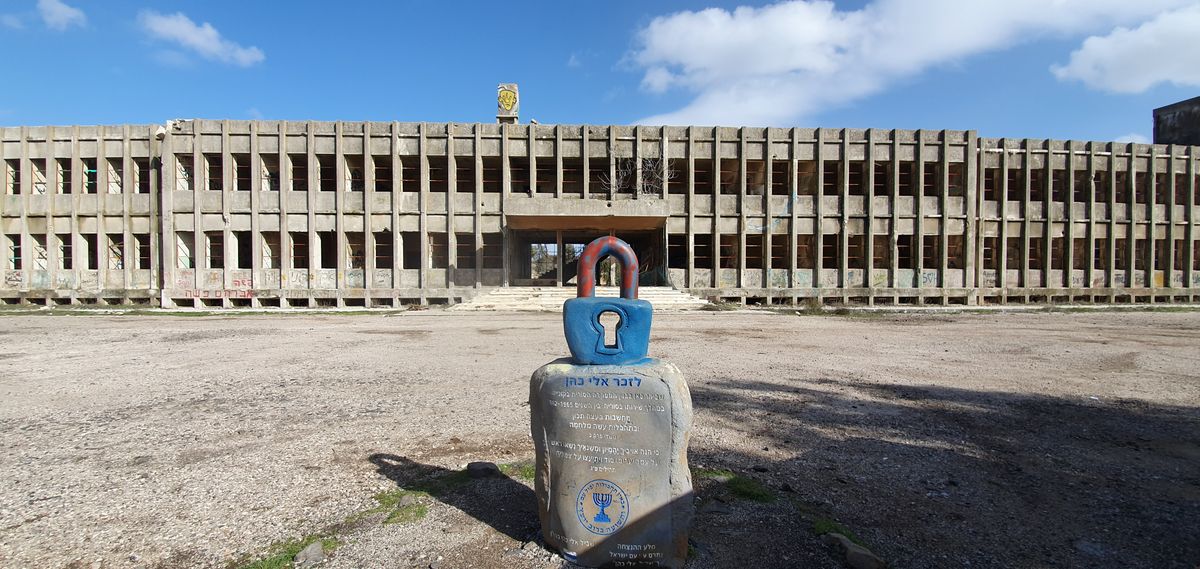
On the outskirts of Quneitra, the abandoned Syrian city on the Golan Heights, stand the remains of the Syrian military headquarters that once commanded the entire Golan front. The complex, captured by Israeli forces during the Six-Day War in 1967 and overrun again during the Yom Kippur War in 1973, is a stark reminder of what the Golan Heights was before Israel took control: a military platform aimed squarely at the communities in the valleys below.
Command Center – Syrian Military Headquarters on the Golan Heights
The Syrian headquarters on the Golan Heights was the nerve center of the military infrastructure that covered the plateau from 1948 to 1967. From this position, Syrian commanders directed the artillery batteries, observation posts, and infantry positions that controlled the heights overlooking the Sea of Galilee and the Hula Valley.
The complex included bunkers, communications facilities, and command rooms built to withstand aerial bombardment. The concrete construction was heavy and deep, designed to protect the command staff while maintaining communications with the network of positions spread across the plateau. The scale of the fortifications reflects the strategic importance that Syria placed on the Golan Heights and the resources it invested in maintaining military control of the high ground.
Quneitra: The Ghost City
The city of Quneitra, which served as the civilian capital of the Golan Heights under Syrian rule, is visible from several points on the Israeli side of the ceasefire line. The city was captured by Israel in 1967, returned to Syria as part of the 1974 disengagement agreement, and has remained largely abandoned since. The empty buildings and deserted streets are visible from the Israeli viewpoints on Mount Bental and other positions along the border.
Syria has maintained Quneitra in its damaged state as a political statement, and the city is occasionally used for official tours intended to demonstrate the effects of the 1967 war. For visitors on the Israeli side, the view of the empty city is a powerful and sobering sight, a reminder that the conflicts that shaped this landscape left marks that have not been erased.
Eli Cohen Passed Through Here
The Syrian headquarters has a direct connection to the most famous spy in Israeli history. Eli Cohen, operating under his cover identity as Kamel Amin Thabet, visited the headquarters complex during his intelligence-gathering tours of the Golan Heights. He passed through the command center to obtain authorization to continue south toward al-Hamma (today’s Hamat Gader), using his connections with senior Syrian officers to access areas that no outsider should have been able to reach. The intelligence he gathered at and around this facility contributed directly to the Israeli military’s detailed knowledge of Syrian positions when the war came in 1967.
From Military Platform to Living Community
The transformation of the Golan Heights from a Syrian military platform to an Israeli civilian landscape is one of the most dramatic changes in the modern history of the region. Where Syrian bunkers and artillery positions once stood, there are now kibbutzim, vineyards, cattle ranches, and nature reserves. The military infrastructure that was built to threaten the communities below has been replaced by a civilian society that contributes to Israel’s agriculture, tourism, and wine industry.
The old Syrian positions, preserved as memorial sites, serve as a reminder of what the Golan was and why Israel considers its control of the plateau essential to the security of its northern communities.
Visit with Hoshen Tours
The Syrian military heritage on the Golan Heights is a powerful and essential part of understanding the region. Hoshen Tours includes the military sites, from the Syrian headquarters complex to the bunkers of Mount Bental and the battlefields of Tel Fakher and Tel Saki, in itineraries that give visitors a complete picture of how the Golan was won and what it means today.
Because understanding where you are standing is the beginning of understanding everything else. And on the Golan Heights, the ground has a lot to say.
Nearby destinations worth combining with this stop include Battle of Tel Fakher, Valley of Tears, and Mount Bental.
Explore Our Tour Collection
Ready to experience Israel in true colors?
Plan Your TourPrivate tours designed around your interests, schedule, and pace.