



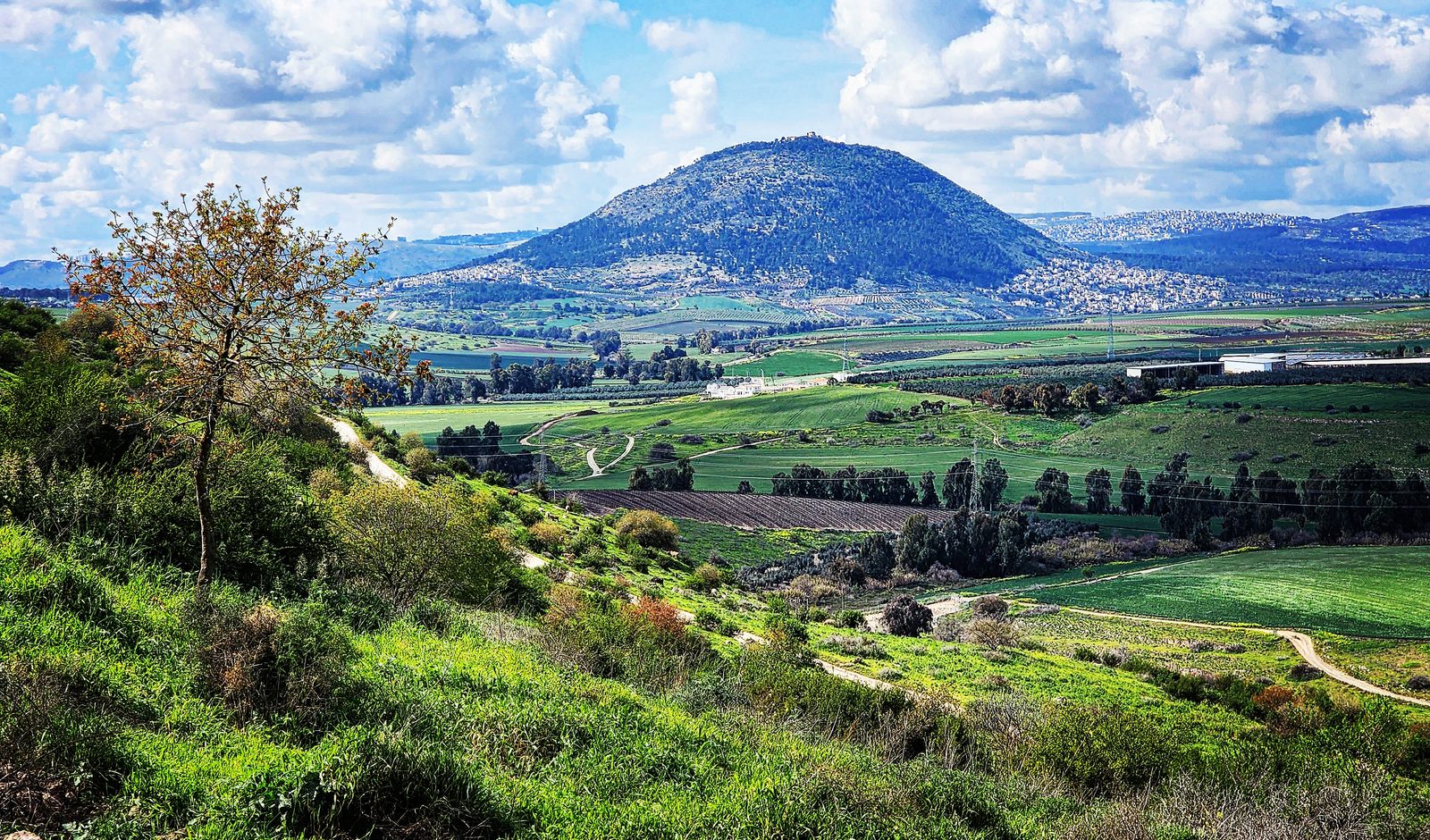
Mount Tabor rises from the floor of the Jezreel Valley like a perfectly shaped dome, 588 meters high and visible from almost everywhere in the Lower Galilee. Its distinctive silhouette has made it a landmark since antiquity. This mountain is tied to two of the most important events in the Bible: the battle of Deborah and Barak against the Canaanite general Sisera, and — by Christian tradition — the Transfiguration of Jesus. The Psalmist knew the power of this place: “Tabor and Hermon sing for joy at your name” (Psalm 89:12).
Deborah and Barak
Before the Transfiguration, Mount Tabor was already famous as the staging ground for one of the most dramatic battles in the Bible. The prophetess Deborah, the only female judge of Israel, summoned the warrior Barak and commanded him: “Go, take with you ten thousand men of Naphtali and Zebulun and lead them up to Mount Tabor. I will lead Sisera, the commander of Jabin’s army, with his chariots and his troops to the Kishon River and give him into your hands” (Judges 4:6–7). Barak replied that he would only go if Deborah went with him. She agreed, but warned him: “The honor will not be yours, for the Lord will deliver Sisera into the hands of a woman” (Judges 4:9).
The battle unfolded exactly as Deborah prophesied. Barak’s forces charged down from Mount Tabor into the Jezreel Valley, and a sudden rainstorm turned the Kishon River into a flood that bogged down Sisera’s 900 iron chariots. The Song of Deborah, one of the oldest passages in the Bible, celebrates the victory: “The river Kishon swept them away, the age-old river, the river Kishon. March on, my soul; be strong!” (Judges 5:21). Sisera fled on foot and was killed by Jael, a woman who drove a tent peg through his temple while he slept. Standing on Mount Tabor, looking down at the Kishon Valley where the chariots became trapped, the military geography of the story is immediately clear.
The Transfiguration
According to the Gospels of Matthew, Mark, and Luke, Jesus took Peter, James, and John to the top of a high mountain, where he was transfigured before them: his face shone like the sun, and his clothes became dazzling white. Moses and Elijah appeared beside him, representing the Law and the Prophets. A voice from heaven declared: “This is my Son, whom I love; with him I am well pleased. Listen to him!” (Matthew 17:5). Peter, overwhelmed, offered to build three shelters, one for Jesus, one for Moses, one for Elijah. The moment revealed Jesus’ divine nature to the three disciples who would later witness his agony in Gethsemane.
Church of the Transfiguration
The church that crowns the summit was designed by the Italian architect Antonio Barluzzi and completed in 1924, built over the ruins of a 4th-century Byzantine church and a 12th-century Crusader church. Barluzzi, sometimes called “the Gaudí of the Holy Land,” designed each of his churches to make visitors feel the event it commemorates, and here, the event is the moment when divinity broke through the ordinary world in a flash of light.
The facade tells the story before you enter. Two flanking towers, shorter than the central nave, represent Moses and Elijah; the taller nave between them represents Jesus. All three are topped with pitched roofs shaped like tents, the three shelters Peter impulsively offered to build: “Lord, it is good for us to be here. If you wish, I will put up three shelters, one for you, one for Moses and one for Elijah” (Matthew 17:4). The architectural style draws on 4th, 6th century Syrian church design, particularly the Church of St. Simeon Stylites, blended with Romanesque elements.
Inside, Barluzzi designed the nave as a journey from darkness to light, an architectural enactment of the Transfiguration itself. The entrance is deliberately kept dark, with heavy stone arches and small windows. As you walk toward the altar, the space opens and light floods in through the apse, where a golden mosaic of the Transfiguration glows: Jesus in radiant white, flanked by Moses and Elijah, with Peter, James, and John cowering below. The effect is powerful. You walk from the ordinary world into divine light, exactly as the three disciples experienced on this mountain.
The Byzantine Era
Two side chapels flank the main apse, dedicated to Moses and Elijah. The Moses chapel depicts the giving of the Law at Sinai; the Elijah chapel depicts the confrontation with the prophets of Baal on Mount Carmel, connecting the Transfiguration to the two great theophanies of the Hebrew Bible.
Beneath the modern church, a crypt preserves remains from both earlier churches. Steps lead down to a chamber at the level of the Byzantine church, where fragments of walls, mosaics, and columns survive from the 4th century. Three grottoes from the Crusader period are also visible, said to represent the three shelters Peter wanted to build. Through a glass panel in the floor, visitors can look down at the layered remains, over 1,600 years of continuous worship on this summit.
The Franciscan church is not the only one on Mount Tabor. On the northern side of the summit stands the Greek Orthodox Church of St. Elijah (Elias), dedicated to the prophet who appeared alongside Moses at the Transfiguration. The two churches share the mountaintop, each marking the same event from its own tradition.
The Ascent
The road to the summit is a series of tight switchbacks through Mediterranean forest, and the sense of ascending to something special builds with every turn. At the top, the views are extraordinary: the Jezreel Valley to the south and west, Nazareth to the northwest, and the Sea of Galilee glimmering to the east. On clear days, Mount Hermon is visible on the far northern horizon. The two mountains paired in Psalm 89, singing together.
Visit with Hoshen Tours
Mount Tabor is a highlight of any Lower Galilee itinerary. Hoshen Tours ascends to the summit, tells the story of Deborah’s battle and Jesus’ Transfiguration, and times the visit to experience Barluzzi’s light effect in the apse. The mountain combines naturally with Nazareth, Kfar Kana, and the Galilee countryside that spreads below.
Visitors exploring the Galilee often combine Mount Tabor with nearby destinations such as Nazareth, Mount Precipice, and Nahal Tavor, each offering its own distinctive perspective on the region’s layered history and landscape. A broader itinerary might also include Zippori and Jesus Trail, both within easy reach and rich in their own right.
Every Hoshen Tours itinerary is private and fully customizable. Contact us to begin planning your journey through the Galilee.
Explore Our Tour Collection
Ready to experience Israel in true colors?
Plan Your TourPrivate tours designed around your interests, schedule, and pace.