



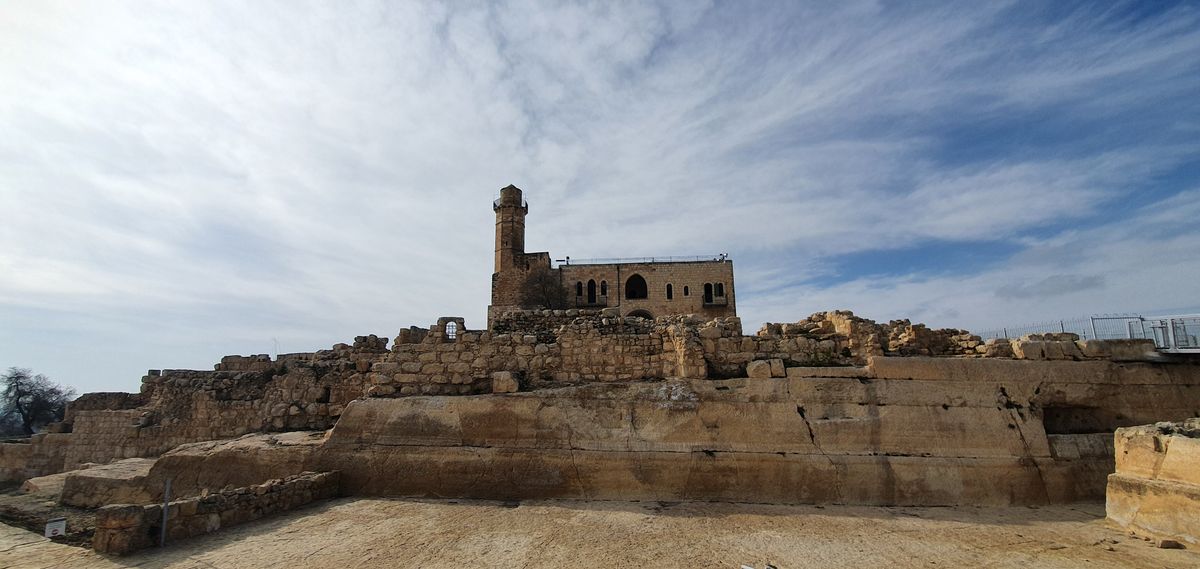
Nabi Samwil (the Tomb of the Prophet Samuel) stands on one of the highest peaks near Jerusalem, approximately 908 meters above sea level, offering a 360-degree panoramic view that stretches from the Mediterranean coast to the mountains of Moab. The hilltop, about 5 kilometers northwest of the Old City, is traditionally identified as the burial place of the prophet Samuel, one of the most pivotal figures in the Hebrew Bible. The site is sacred to Jews, Christians, and Muslims alike, and the building that crowns the hill reflects that shared reverence: a mosque on the upper level and a Jewish prayer space around the cenotaph on the lower level, built over Crusader foundations, all atop a hilltop that has been a landmark for travelers approaching Jerusalem for thousands of years.
The Prophet Samuel
Samuel’s story begins with his mother, Hannah, one of the most compelling figures in the Bible. Hannah was childless, and her anguish was deepened by the taunts of her husband Elkanah’s other wife, Peninnah, who had children. During the family’s annual pilgrimage to the Tabernacle at Shiloh, Hannah prayed silently with such intensity that the priest Eli, seeing her lips move without sound, thought she was drunk. When he realized she was pouring out her soul before God, he blessed her. Hannah made a vow: if God granted her a son, she would dedicate him to the Lord’s service for his entire life (1 Samuel 1:11). God answered her prayer, and she named her son Samuel, meaning “asked of God.”
After weaning the child, Hannah brought the young Samuel to the Tabernacle at Shiloh and presented him to Eli, saying: “For this child I prayed, and the Lord has granted me my petition. Therefore I have lent him to the Lord; as long as he lives he shall be lent to the Lord” (1 Samuel 1:27-28). She then sang a prayer of thanksgiving (1 Samuel 2:1-10) that is regarded as one of the great poetic passages in the Hebrew Bible and is seen in Christian tradition as a precursor to Mary’s Magnificat. The boy grew up serving in the Tabernacle under Eli, wearing a small linen ephod, while Eli’s own sons, Hophni and Phinehas, disgraced the priesthood through corruption and abuse.
One night, while Samuel slept near the Ark of God, he heard a voice calling his name. Thinking it was Eli, he ran to the old priest. This happened three times before Eli understood that God was calling the boy and told him to answer: “Speak, Lord, for Your servant hears” (1 Samuel 3:9). God revealed to Samuel the coming judgment against Eli’s house. From that night onward, Samuel was recognized as a prophet throughout Israel, “from Dan to Beersheba” (1 Samuel 3:20).
Samuel in Jewish and Islamic Tradition
Samuel became the last of the Judges, the spiritual and political leader who held Israel together during the turbulent period between the age of the Judges and the monarchy. He traveled an annual circuit through Bethel, Gilgal, and Mizpah, judging the people and returning to his home in Ramah (1 Samuel 7:15-17). When the elders of Israel demanded a king “like all the nations,” Samuel was deeply troubled, but God told him to heed their request. Samuel anointed Saul, son of Kish, of the tribe of Benjamin, as Israel’s first king (1 Samuel 10:1). When Saul later disobeyed God’s commands, Samuel delivered the devastating verdict: “The Lord has torn the kingdom of Israel from you today and has given it to a neighbor of yours, who is better than you” (1 Samuel 15:28). God then sent Samuel to Bethlehem, to the house of Jesse, where he anointed the youngest son, David, as the future king. Seven older brothers passed before Samuel, but God told him: “Man looks at the outward appearance, but the Lord looks at the heart” (1 Samuel 16:7). Samuel anointed David, and the Spirit of the Lord came upon the shepherd boy from that day forward.
Samuel died and was buried at his home in Ramah, and “all Israel gathered together and lamented for him” (1 Samuel 25:1). Even after death, his presence haunted the narrative: on the eve of his final battle at Mount Gilboa, a desperate Saul summoned Samuel’s spirit through the medium at En-dor (1 Samuel 28), a scene that remains one of the most haunting episodes in the Bible.
The Hilltop and Its Traditions
Tradition holds that this hilltop is the site of biblical Ramah, Samuel’s home and burial place. The identification has been maintained in Jewish, Christian, and Muslim traditions for many centuries, with the earliest clear references dating to the Byzantine period. It should be noted that scholars debate the identification: some locate biblical Ramah at er-Ram, about 8 kilometers north of Jerusalem, or at other sites. There is no definitive archaeological proof linking this specific hilltop to the Ramah of Samuel. But the tradition is ancient, deeply held across three faiths, and the site’s commanding position above Jerusalem gives it a spiritual authority that feels earned.
During the Crusader period, a church and monastery were built here in the 12th century. The Crusaders called the hill Mons Gaudii, “Mount of Joy,” because this was the point from which pilgrims approaching from the coast first caught sight of Jerusalem. According to tradition, upon reaching the summit and seeing the Holy City for the first time, pilgrims would weep with joy. The most famous story associated with the site belongs to Richard the Lionheart: during the Third Crusade in 1191-1192, when Richard reached this hilltop and could see Jerusalem in the distance, he is said to have shielded his eyes or covered his face with his shield, declaring that he was not worthy to look upon Jerusalem if he could not deliver it. He withdrew without besieging the city.
After Saladin’s forces recaptured the region from the Crusaders in 1187, the church was converted into a mosque during the Mamluk period, and a minaret was added. The tomb below continued to be venerated by all three faiths. During the Ottoman period, Jewish pilgrimage to the site persisted, particularly on the traditional anniversary of Samuel’s death. In 1948, the hilltop became the scene of fierce fighting during the battle for the Jerusalem corridor. The Palmach’s Harel Brigade attempted to capture the strategically vital site during Operation Yevusi, but after intense combat, Nabi Samwil remained under Jordanian control until the Six-Day War in 1967, when Israeli forces captured it along with the rest of the West Bank.
The Tomb of Samuel the Prophet
The structure that stands today reflects every layer of the site’s history. The upper level functions as a mosque, preserving the Mamluk conversion of the Crusader church. The hall retains Crusader-era pointed arches and stone construction beneath its Islamic modifications, and the minaret is visible from a great distance. The lower level contains a subterranean chamber with a cenotaph traditionally identified as the tomb of Samuel. This space has been arranged as a Jewish prayer area, with an ark, Torah scrolls, and prayer furnishings. Jewish worshippers pray here at the cenotaph, while Muslim worshippers use the mosque above.
The Panoramic View of Jerusalem and the Judean Hills
The panoramic view from the rooftop is one of the finest in the Jerusalem region. To the south and southeast, the Old City of Jerusalem, the golden Dome of the Rock on the Temple Mount, and the Mount of Olives ridge behind it are all visible on a clear day, with the modern neighborhoods of Jerusalem spreading across the hills between. To the west, the Judean Hills drop away toward the Shephelah lowlands and the coastal plain, and on clear days the Mediterranean Sea and the Tel Aviv skyline are visible on the horizon. To the north, the hills of the Benjamin region roll toward Ramallah, with the village of al-Jib (biblical Gibeon) in the valley below. To the east, the ridgeline of the central watershed stretches into the distance. The strategic importance of this view explains everything about the site’s military history: any force controlling Nabi Samwil could observe every approach to Jerusalem from the north and northwest, the primary routes from the coastal plain to the Holy City.
Visit with Hoshen Tours
Nabi Samwil offers the story of one of the Bible’s greatest prophets, a building that encapsulates Jewish-Christian-Muslim shared history, and a view that explains why every army that ever approached Jerusalem wanted this hilltop. Hoshen Tours tells the full story, from Hannah’s prayer at Shiloh to Richard the Lionheart’s refusal to look upon the city, and lets the panorama speak for itself. Hoshen Tours often combines this site with Chagall Windows Hadassah, Tomb of Lazarus, and Rachels Tomb for a memorable day exploring the region.
Explore Our Tour Collection
Ready to experience Israel in true colors?
Plan Your TourPrivate tours designed around your interests, schedule, and pace.