



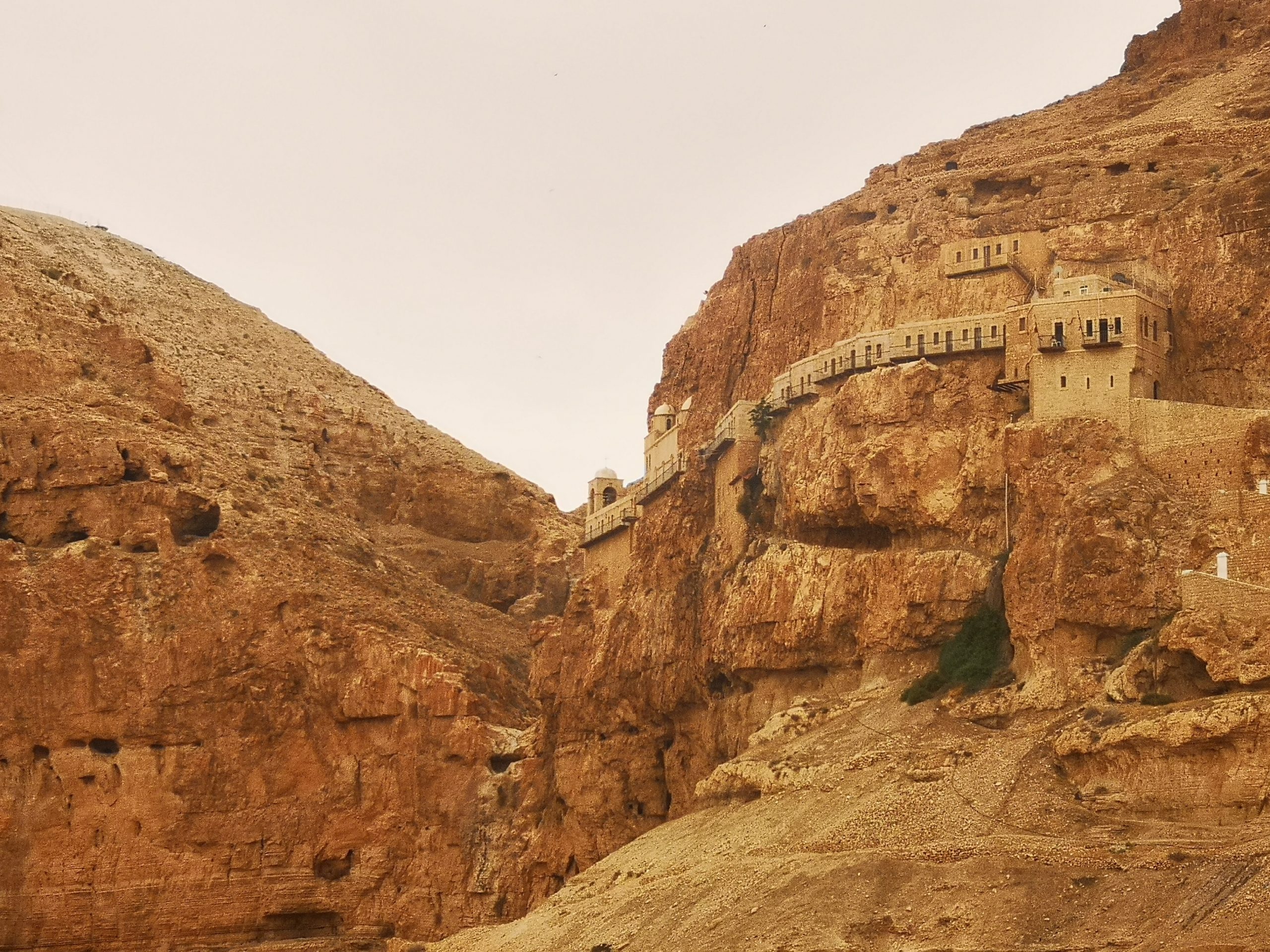
The Mount of Temptation Israel (Jebel Quruntul, from the Latin “quarantena” meaning forty) rises above Jericho in a sheer cliff face that dominates the landscape of the oldest city in the world. This is the mountain where, according to Christian tradition, Jesus spent 40 days fasting in the wilderness and was tempted by the devil: “The devil took him to a very high mountain and showed him all the kingdoms of the world and their splendor. ‘All this I will give you,’ he said, ‘if you will bow down and worship me.’ Jesus said to him, ‘Away from me, Satan! For it is written: Worship the Lord your God, and serve him only’” (Matthew 4:8-10).
The Greek Orthodox Monastery of the Temptation
The Greek Orthodox Monastery of the Temptation (Deir al-Qurantul) clings to the cliff face roughly 350 meters above Jericho, built into natural caves and rock ledges in a way that seems to defy both gravity and engineering. The original monastery was established in the 6th century by Byzantine monks drawn to the site by its association with Jesus’s fast. It was destroyed and rebuilt several times, with the current structure dating largely to a reconstruction begun in 1895 by the Greek Orthodox Patriarchate of Jerusalem. Inside, a stone is traditionally identified as the place where, according to tradition, Jesus sat during the temptation. The chapel is carved directly into the rock, its walls blackened by centuries of candle smoke and incense. Several caves behind and above the monastery are still accessible, small, dark chambers where early monks lived in deliberate solitude, emulating the 40-day fast in conditions of extreme austerity.
The Douka Laura
Long before the current monastery was built, this cliff served as one of the earliest centers of Christian monasticism in the Holy Land. Around 340 CE, Chariton the Confessor, a monk from Iconium in Asia Minor who had been captured by bandits and miraculously escaped, founded the Douka Laura here. It was the third of three lauras (monastic communities) he established in the Judean Desert, after Pharan near Ein Prat and Souka in Nahal Tekoa. In a laura, monks lived in individual caves during the week, practicing solitary prayer and manual labor, and gathered together only on Saturday for communal worship and a shared meal. Remains of their cells, cisterns for rainwater collection, and narrow paths connecting the caves are still visible in the cliff face above the monastery. The Douka Laura survived into the early Islamic period before falling into ruin, but its legacy shaped the monastic tradition that would flourish across the Judean Desert for centuries.
The Three Temptations
The Gospel accounts (Matthew 4:1–11 and Luke 4:1–13) describe three distinct temptations, each representing a different kind of power. First, the devil challenged Jesus to turn stones into bread, a test of whether physical hunger would override trust in God. Jesus responded with Deuteronomy 8:3: “Man shall not live by bread alone, but by every word that comes from the mouth of God.” Second, the devil took him to the pinnacle of the Temple in Jerusalem and urged him to throw himself down, quoting Psalm 91 to suggest that angels would catch him. Jesus refused, citing Deuteronomy 6:16: “You shall not put the Lord your God to the test.” Third, and this is the temptation most powerfully evoked by the view from this mountain, the devil showed him all the kingdoms of the world and offered them in exchange for worship. Jesus’s final answer came from Deuteronomy 6:13: “You shall worship the Lord your God, and him only shall you serve.” Standing on this cliff, looking out over the Jordan Valley toward the mountains of Moab and the shimmering Dead Sea, visitors can feel the force of that third temptation in a way that no text alone can convey.
A cable car carries visitors from the center of Jericho up to the monastery, offering panoramic views of Jericho, the Jordan Valley, the Dead Sea, and the mountains of Jordan. The ride is short but dramatic, and the view from the monastery terrace encompasses the entire northern Dead Sea region.
View from the Top
From the summit of the mountain, above the monastery, the panorama extends in every direction. The devil’s offer to Jesus, “all the kingdoms of the world,” makes geographic sense from this vantage point: the Jordan Valley stretches north and south, the mountains of Moab rise to the east, and the Judean hills roll westward toward Jerusalem. Whether or not the devil literally brought Jesus here, the view is the kind that makes you understand the temptation.
Visit with Hoshen Tours
The Mount of Temptation rises above Jericho with a monastery perched on its cliff. Hoshen Tours pairs it with the wider story of Jericho, the Hasmonean Palaces at Jericho, the monastery of Deir Hajla Monastery, and the mosaic at the Shalom Al Yisrael Synagogue.
Explore Our Tour Collection
Ready to experience Israel in true colors?
Plan Your TourPrivate tours designed around your interests, schedule, and pace.