



The Sea of Galilee is not a sea. It is a freshwater lake, roughly 21 kilometers long and 13 kilometers wide, and 43 meters at its greatest depth, sitting 209 meters below sea level in the rift valley of northern Israel, the lowest freshwater lake on earth. But what it lacks in oceanic credentials, it more than compensates for in historical, spiritual, and ecological significance. This is the lake where, according to the Gospels, Jesus walked on water, calmed the storm, called his first disciples from their fishing boats, and performed many of his most celebrated miracles. It is also Israel’s primary natural freshwater reservoir, the source of the National Water Carrier, and one of the most beautiful bodies of water in the Middle East.
Geography and Setting
The Sea of Galilee sits in the Jordan Rift Valley, part of the same geological trench that extends from the Lebanese mountains in the north to the Red Sea in the south. The lake measures approximately 21 kilometers from north to south and 13 kilometers at its widest point east to west. Its maximum depth of 43 meters makes it shallow by the standards of the world’s great lakes, yet this shallowness contributes to the sudden, violent storms for which it has been famous since antiquity, storms that can transform a glass-smooth surface into a chaos of whitecaps within minutes as warm air from the rift valley collides with cold air rushing down from the surrounding heights.
The Golan Heights rise sharply on the eastern shore, their dark basalt cliffs and plateau forming a dramatic backdrop that catches the morning light. The gentler slopes of the lower Galilee hills roll away to the west, covered in scrub and terraced farmland. The Jordan River enters the lake from the north, fed by the snows of Mount Hermon and the springs of the upper Galilee, and exits from the south, continuing its descent toward the Dead Sea. The entire hydrological system, snowmelt, springs, lake, and river, connects the summit of Hermon to the Jordan Valley in a single continuous flow.
Names Through the Ages
Few bodies of water in the world carry as many names as this lake, and each name reflects a different layer of the history that has accumulated on its shores. In Hebrew it is called the Kinneret, a name that appears already in the Hebrew Bible, in the book of Numbers (34:11) and the book of Joshua (13:27). The origin of the name is debated. One widely cited explanation derives it from the Hebrew word for harp, kinnor, because the lake’s outline, when viewed on a map, vaguely resembles the shape of that ancient instrument. Another tradition connects the name to the ancient city of Kinneret that stood on its northwestern shore during the biblical period. Both explanations may preserve something true, and neither has been established conclusively by modern scholarship.
In the New Testament, the lake is called the Sea of Galilee, the name by which it is most widely known in the Christian world, as well as the Sea of Gennesaret (Luke 5:1), a name that reflects the fertile plain on its northwestern shore. In Greek and Roman geography, and in the naming traditions of the Byzantine and Islamic periods, it is often called Lake Tiberias, after the city founded on its western shore by Herod Antipas around 20 CE and named in honor of the emperor Tiberius. In modern Israel, the official Hebrew name is Yam HaKinneret, but the name Kinneret alone is used in everyday speech, in weather forecasts, in water authority reports, and in the national consciousness of a country for whom this lake carries layers of meaning that no single name fully captures.
Water, Life, and the National Obsession
The Sea of Galilee is Israel’s largest natural freshwater reservoir, and in a country where water scarcity is a permanent fact of life, the lake’s level is a matter of genuine public concern. The National Water Carrier, completed in 1964, pumps water from the lake through a system of pipes, tunnels, and open canals southward to the agricultural lands and cities of central Israel. For decades the lake functioned as the main source of Israel’s national water supply, and its level was watched with an attention that bordered on the obsessive.
The Israeli Water Authority tracks critical threshold levels, the “red line” and the “black line”, below which ecological damage accelerates and pumping must eventually cease. During drought years, the Kinneret’s level appeared in news broadcasts alongside weather and traffic. No body of water in Israel carries this weight of collective concern.
The Gospel on the Lake
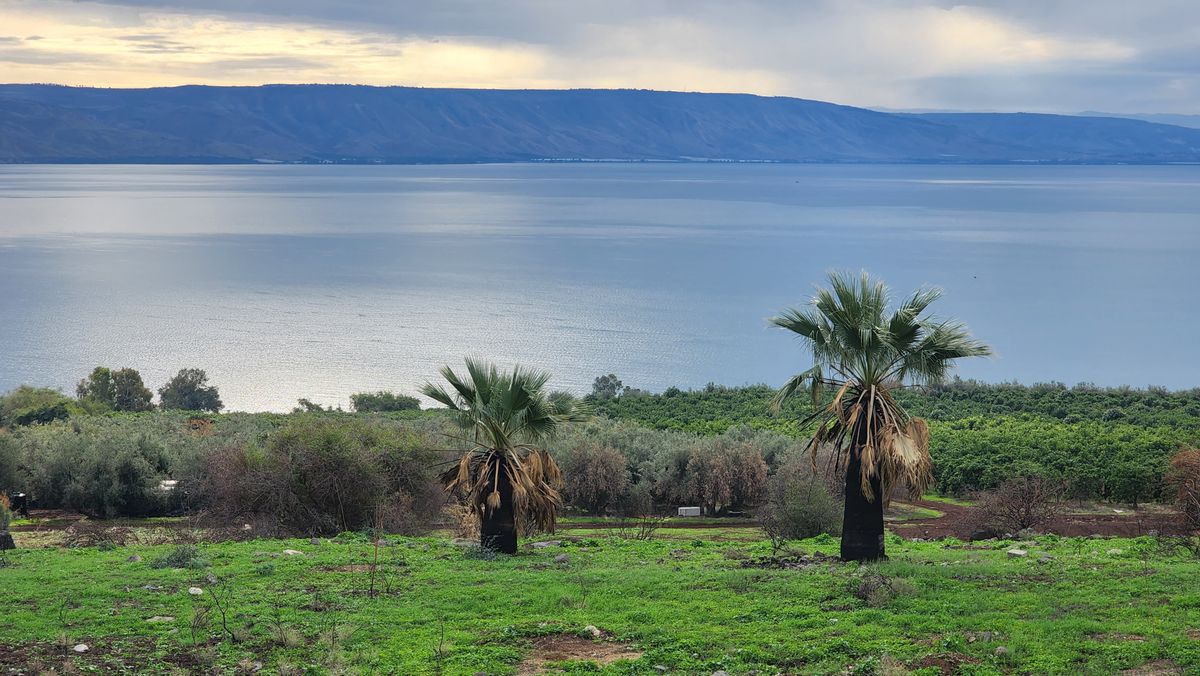
More of Jesus’s ministry took place around the shores of this lake than anywhere else in the Gospel accounts. The northwestern shore in particular, with its string of fishing villages, its synagogues, and its roads connecting the Galilee to the wider world, was the heartland of his public activity. It was here that he called his first disciples: Simon Peter and his brother Andrew, casting their net into the sea, and James and John, the sons of Zebedee, mending their nets in a boat. Tradition holds that he said to them, “Come, follow me, and I will send you out to fish for people” (Matthew 4:18-22).
The storm narratives that appear in three of the four Gospels are vivid with the meteorological reality of this lake. In Mark’s account, a great windstorm arose while tradition holds that Jesus slept in the stern of the boat, and the disciples woke him in fear: “Teacher, don’t you care if we drown?” He woke, rebuked the wind, and said to the sea, “Peace! Be still!” The wind ceased and there was a great calm (Mark 4:35-41). In Matthew’s account, Peter asks to come to Jesus on the water, steps out of the boat, walks, and then, seeing the wind, begins to sink. “Lord, save me!” Jesus reaches out his hand and catches him: “You of little faith, why did you doubt?” (Matthew 14:22-33). These episodes are among the Gospel’s most theologically charged moments, set against the specific physical reality of a lake whose sudden storms were well known to every fisherman on its shores.
The Gospel Connection
The miraculous catch of fish appears in two Gospel accounts. In Luke 5:1-11, tradition holds that Jesus, teaching from Simon’s boat on the lake he calls the Sea of Gennesaret, tells the fishermen who have caught nothing all night to put out into the deep and let down their nets. The catch is so large that the nets begin to tear and the boats begin to sink with the weight of the fish. In John 21:1-14, the risen Jesus appears on the shore at dawn, unrecognized, and calls to the disciples fishing nearby to cast their net on the right side of the boat. Again the net fills, 153 fish, the text specifies, a number that has generated centuries of theological commentary. Jesus has prepared a charcoal fire on the shore. “Come and have breakfast,” he says. The lake is the setting of the first resurrection appearance to a group of disciples, and the breakfast on the shore is among the most humanly intimate scenes in the entire New Testament.
Fishing on the Kinneret
The Sea of Galilee has been fished continuously for thousands of years. The ancient fishermen of Galilee, men like Peter, Andrew, James, and John, worked the lake with nets thrown from small wooden boats, fishing at night when the fish rose closer to the surface and hauling their catch to shore before dawn. The fish markets of Magdala, on the lake’s northwestern shore, supplied salted and dried fish to markets across the Roman Empire.
The lake’s most celebrated resident is the tilapia, specifically Sarotherodon galilaeus, known in Israel as St. Peter’s fish, a name rooted in the Gospel episode (Matthew 17:24-27) in which Peter finds a coin in the mouth of a fish. Tilapia has been the centerpiece of Galilee cuisine for generations, served whole and grilled at restaurants along the waterfront in Tiberias and at lakeside guesthouses. Commercial fishing on the lake still exists, though it has declined significantly over the decades as water levels fluctuated, fishing regulations tightened, and fish farming made wild-caught tilapia harder to sustain economically. Small fishing boats still work the early morning hours on the lake, their lights visible from the shore before dawn, a continuity with the Galilean fishing tradition that stretches back more than two thousand years.
The Sites That Ring the Lake
The shoreline of the Sea of Galilee is among the most historically and spiritually layered stretches of landscape in the world, and the sites that ring it demand time and attention. On the northwestern shore, Capernaum is identified by tradition as the base of Jesus’s Galilean ministry, a fishing village whose 4th-century synagogue preserves the black basalt foundations of an earlier structure believed to be the synagogue in which he taught. At Tabgha, the Church of the Multiplication of the Loaves and Fishes stands over a stunning ancient mosaic floor, and the Church of the Primacy of Peter marks the traditional site of the post-resurrection breakfast on the shore. The Mount of Beatitudes rises above the lake’s northwestern shore, its hilltop church framing one of the most serene views in the Galilee.
Magdala, the first-century town believed to be the hometown of Mary Magdalene, has yielded remarkable archaeological finds, explored in full on the Magdala page. On the eastern shore, Kursi is identified by tradition as the site of the Gadarene miracle (Mark 5:1-20), and a large Byzantine monastery complex has been excavated there. The city of Tiberias anchors the western shore, its promenade and waterfront restaurants alive on warm evenings, while its deeper history connects it to the rabbinic tradition, it is one of Judaism’s four holy cities, the seat of the Sanhedrin after the fall of Jerusalem, and the city where the Jerusalem Talmud was compiled. At the lake’s southern outlet, Yardenit provides a maintained baptismal site on the Jordan River where Christian pilgrims from every tradition enter the water. On the eastern shore, Ein Gev hosts an annual music festival and a fish restaurant overlooking the water that has drawn visitors for decades.
Discovered in 1986 when a prolonged drought exposed mudflats near Kibbutz Ginosar, the Ancient Galilee Boat is a remarkably preserved 1st-century wooden vessel of the type Jesus and his disciples would have used on the lake. It is now displayed in a purpose-built museum at Kibbutz Ginosar, full details on the Ancient Galilee Boat page.
Visit with Hoshen Tours
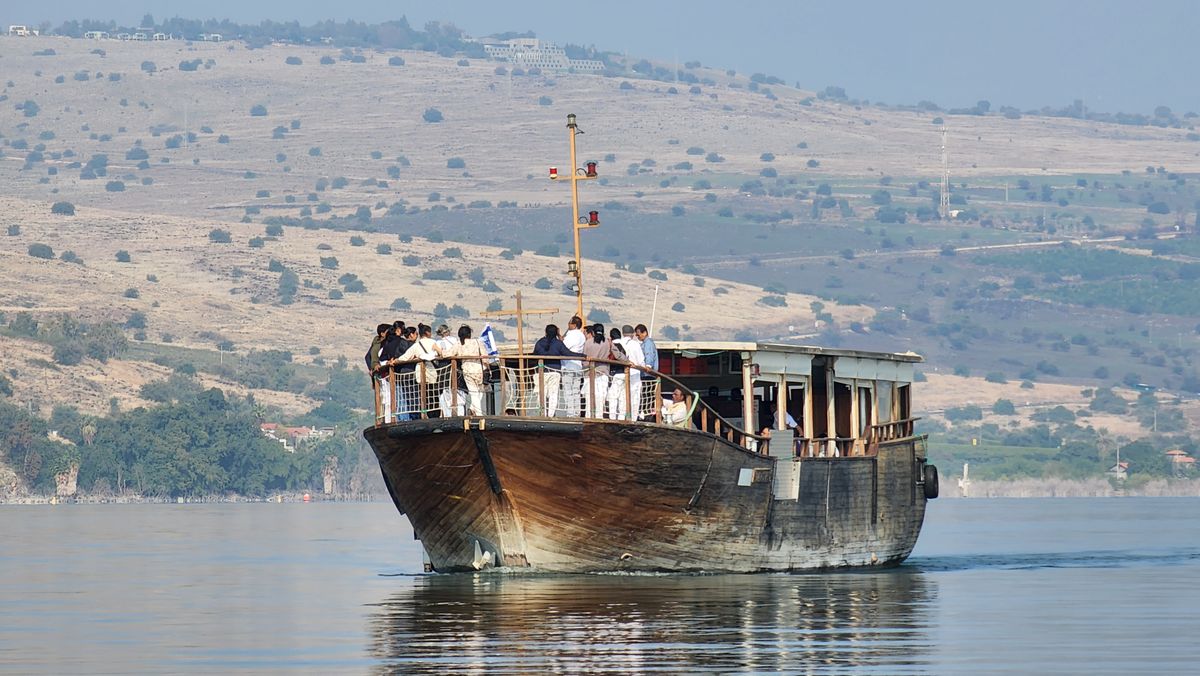
The Sea of Galilee is the centerpiece of any Christian pilgrimage to Israel and one of the great experiences of any journey to the north of the country. Among the most moving experiences for Christian pilgrims is a boat ride on the lake itself, traditional wooden boats cross the open water while passengers read from the Gospels and sing hymns, the Golan Heights rising to the east and the hills of Galilee to the west, the lake stretching out in every direction much as it did in the time of Jesus. A full day on the lake, circling its shores, visiting the Gospel sites, stepping aboard a pilgrim boat, and viewing the ancient Galilee Boat at Ginosar, is an experience that stays with visitors long after they have returned home. Hoshen Tours designs private, custom itineraries that move thoughtfully between the sacred and the scenic, connecting the ancient shore to the living landscape, and bringing the Gospel stories into the specific, concrete, geographical world in which they unfolded. Contact us to plan your Galilee day.
Visitors exploring the Galilee often combine Sea of Galilee with nearby destinations such as Capernaum, Tiberias, and Tabgha, each offering its own distinctive perspective on the region’s layered history and landscape. A broader itinerary might also include Mount Arbel and Church of the Primacy of Peter, both within easy reach and rich in their own right.
The Sea of Galilee is a highlight of every Holy Land pilgrimage tour. Let us help you plan a journey that brings these shores to life.
Explore Our Tour Collection
Explore this site and 65 more in Sacred Steps in the Holy Land
225 pages · The Life, World, and Footsteps of Jesus · Maps, photos, and Scripture references
Ready to experience Israel in true colors?
Plan Your TourPrivate tours designed around your interests, schedule, and pace.