



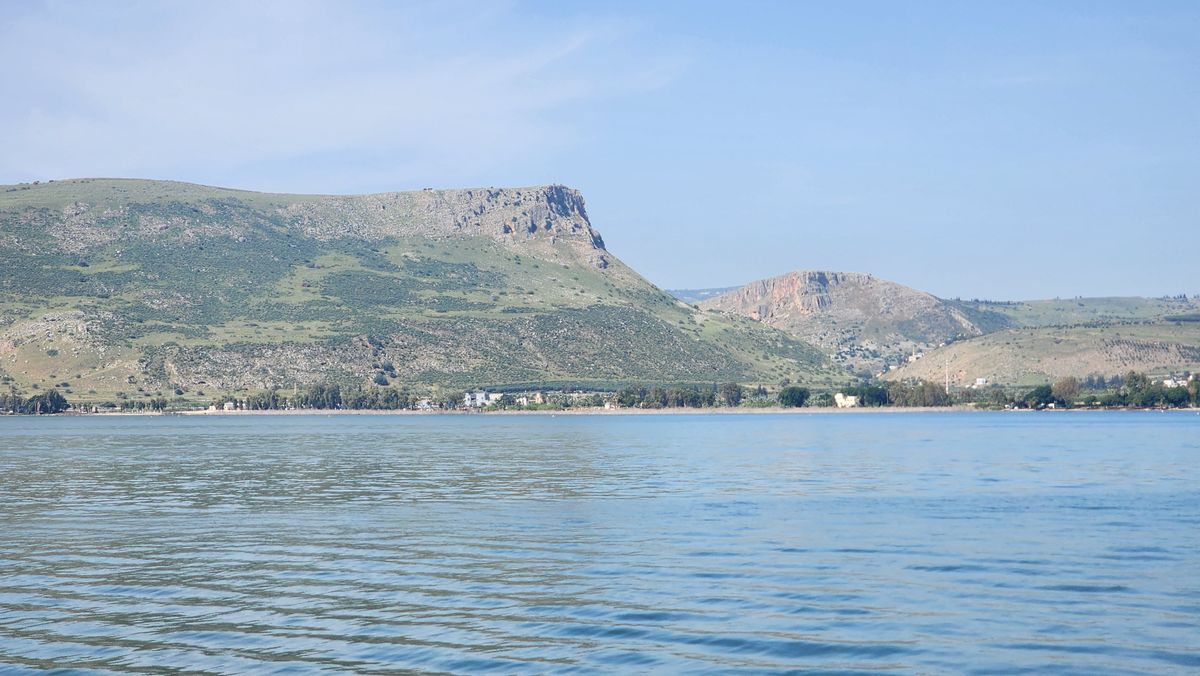
Mount Arbel is a sheer cliff rising 390 meters above the Sea of Galilee on its western shore, offering what many consider the finest view of the lake and the most dramatic natural landscape in the Lower Galilee. The cliff face drops nearly vertically to the valley below, and the view from the summit encompasses the entire Sea of Galilee, the Golan Heights, Mount Tabor, and on clear days, Mount Hermon. The mountain has layers of meaning, geological drama, a biblical-era battlefield, a natural fortress used across centuries, and a sanctuary for wildlife, all visible from a single clifftop perch.
The Cliff and the Nature Reserve
Arbel is protected within the Arbel Nature Reserve, a designated reserve that covers the cliff, the valley, and the slopes descending to the Arbel Stream. The cliff itself is composed of Cretaceous limestone, fractured and weathered into its characteristic sheer face over millions of years. The reserve is home to diverse birdlife, raptors nest in the cliff face, including griffon vultures and lesser kestrels, and the thermals rising off the warm basalt valley make it an exceptional spot for watching birds of prey soar at eye level. In spring, the slopes are carpeted in wildflowers: red anemones, cyclamen, and poppies against the grey limestone. The reserve is managed by Israel Nature and Parks Authority, which maintains the trail network and the parking area at the summit.
Cliff Trail
The Arbel cliff trail is one of the most popular hikes in the Galilee and one of the most technically demanding hikes accessible to non-climbers in Israel. The trail descends from the summit through a series of rock-cut steps, metal handholds, and narrow ledges carved into the cliff face over centuries of use. The descent is exposed and dramatic, suitable for hikers with reasonable fitness who are not afraid of heights. At certain points, hikers must lower themselves hand-over-hand using iron pegs and chains bolted into the rock. At the base of the cliff, the trail passes through the ruins of an ancient synagogue and connects to the valley floor. The ascent from below is equally dramatic, and the sense of achievement at reaching the summit is considerable. The full loop, summit to valley via the cliff trail, then back up through the nature reserve, takes approximately three to four hours.
The Caves
The cliff face of Arbel is pocked with caves that have served as hiding places throughout history. Josephus himself fortified Arbel as one of his strongholds when he commanded the Jewish forces in the Galilee during the Great Revolt against Rome (66–67 CE). But the most vivid story belongs to an earlier period: when Herod was fighting to secure his kingdom in 38–37 BCE, Jewish rebels took refuge in these cliffs. Herod’s soldiers could not climb up to the caves from below or descend from above on the sheer rock face. According to Josephus, Herod ordered his men to be lowered in large wooden chests and iron cages from the cliff top, dangling over the abyss, to reach the cave entrances.
From the baskets, they fought the defenders with fire and sword, dragging them out of their hiding places and hurling some over the edge. The image, soldiers swinging in cages above a 110-meter vertical drop, fighting hand to hand at the mouths of caves, is one of the most dramatic in Josephus’s entire account. The caves were used again as refuges during the Bar Kokhba revolt (132–135 CE), and their interiors still bear traces of ancient occupation: blackened ceilings from fires, rock-cut niches, and in some cases, remains of plaster.
The Ancient Synagogue at Arbel Village
At the base of the cliff, near the ancient village of Arbel, stand the remains of a Byzantine-era synagogue dating to the 3rd or 4th century CE. The synagogue is a basalt structure with carved architectural elements, decorated lintels, column capitals, and doorframes, that reflect the high quality of craftsmanship in prosperous Galilean Jewish villages of the period. The building follows the broadhouse plan typical of early Galilean synagogues, with the main hall oriented toward Jerusalem. Several ornamental stones with Jewish symbols have been found at the site, including menorahs and geometric patterns. The synagogue at Arbel is one of a cluster of ancient synagogues in this region, along with those at Capernaum, Chorazin, and Bar’am, that attest to the density of Jewish settlement in the Galilee during the Roman and Byzantine periods. The village of Arbel continued to be inhabited through the medieval period, and traces of later occupation can be seen in the valley below.
Jesus and Arbel
While the Gospels do not mention Arbel by name, the cliff dominates the landscape between Nazareth and Capernaum, the two centers of Jesus’s life. Anyone traveling from Nazareth to the Sea of Galilee, as Jesus did repeatedly, would have passed through the Arbel Valley beneath this cliff. The valley road through Arbel was one of the main ancient routes connecting the interior of the Galilee to the lakeshore, used by farmers, fishermen, and travelers for millennia. The Jesus Trail, the modern hiking route from Nazareth to Capernaum, passes through the Arbel Valley and includes the cliff ascent as one of its highlights.
The View of the Sea of Galilee and Beyond
From the summit, the entire geography of the Galilee is laid out: the Sea of Galilee filling the rift valley below, Tiberias on the western shore, Capernaum and Tabgha on the northern shore, the Mount of Beatitudes above them, and the volcanic plateau of the Golan stretching to the east. To the south, the Jordan Valley extends toward the Dead Sea; to the west, the hills of the Lower Galilee roll toward Nazareth and the Jezreel Valley. On exceptionally clear days, the snow-capped summit of Mount Hermon is visible to the northeast, some 80 kilometers distant. The view at sunrise, when the lake reflects the first light and the mountains glow pink, is one of the great natural spectacles in Israel. At dusk, the cliffs turn amber and the lights of Tiberias begin to appear on the water below.
Visit with Hoshen Tours
Mount Arbel offers the best view of the Sea of Galilee and one of the best hikes in the north. Hoshen Tours includes the cliff trail for groups with the fitness for it, and the summit viewpoint for those who prefer to drive to the top. The site pairs naturally with Magdala, Capernaum, and Tabgha on a Sea of Galilee day, or with the Jesus Trail for groups walking between Nazareth and the lake.
Visitors exploring the Galilee often combine Mount Arbel with nearby destinations such as Sea of Galilee, Tiberias, and Vered HaGalil, each offering its own distinctive perspective on the region’s layered history and landscape. A broader itinerary might also include Nahal Amud and Capernaum, both within easy reach and rich in their own right.
Every Hoshen Tours itinerary is private and fully customizable. Contact us to begin planning your journey through the Galilee.
Explore Our Tour Collection
Ready to experience Israel in true colors?
Plan Your TourPrivate tours designed around your interests, schedule, and pace.